

girls clothes |
- Mother: Teacher in Norfolk made daughter swap 'dirty' clothes with other girl - 13newsnow.com WVEC
- Should These Clothes Be Saved? - The Indian Express
- Redondo Beach teens challenge middle school dress code — and administrators are responding - The Daily Breeze
- Report: Women say former Scottsdale pastor sexually abused them as girls - AZFamily
| Posted: 15 May 2019 01:54 PM PDT  NORFOLK, Va. — A mother is demanding answers after a teacher made her 7-year-old daughter switch clothes with another student. DeKyra Davis said a teacher at Crossroads Elementary School made her daughter, JaeKyra, swap outfits with another girl because the teacher thought JaeKyra's clothes were dirty. "Another student that's bigger than my child walks out in my daughter's clothes. The jeans are all rising because she's taller than Jae, and she's heavier. And I'm like, okay, this child has the clothes that I put on my child's back on her back, now," Davis said. "So I said, 'Why does she have her clothes on?' She was like, 'Oh, I made them switch because I thought the outfit would look better." Davis said that doesn't add up. She questioned if her daughter's clothes were dirty, why did the teacher put them on another student? "I would never send my child out the house, dirty," Davis said. "I've never in my life heard of a teacher taking a student's clothes off another student and putting it on and making them swap back." It happened before an honor roll ceremony during which JaeKyra received an award. In a statement, Norfolk Public Schools officials said they were aware of the incident and the administration at Crossroads Elementary "responded appropriately" in addressing the issue. Davis said administrators switched her daughter to another class with a different teacher, and the principal apologized. School officials said this is a personnel matter, and they wouldn't comment any further. JaeKyra received a certificate that day for making the honor roll, but Davis said her day was ruined. "She walked on her special day. She walked across the stage crying to receive her award that she worked hard for," Davis said. "I feel like what she did was unethical. It was unsanitary, and so much could go wrong." Davis said she's not satisfied with the way the school handled the situation, and she wants the teacher in question to apologize to her daughter.  |
| Should These Clothes Be Saved? - The Indian Express Posted: 29 Apr 2019 12:00 AM PDT 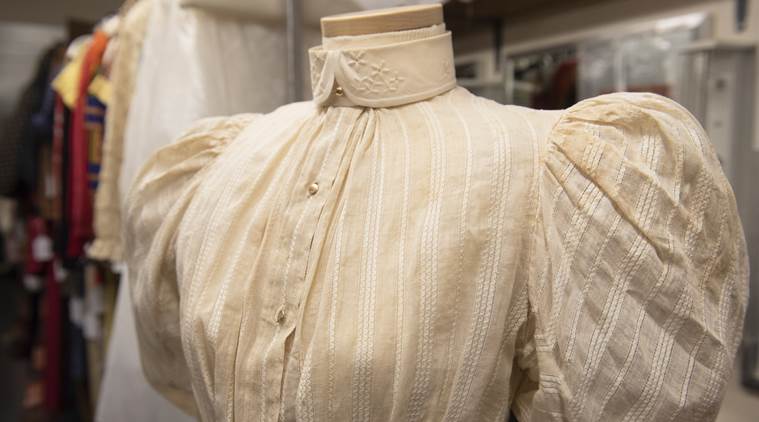 A 1895 cotton shirtwaist blouse with a detachable stiff collar, part of the Smith College Historic Clothing Collection in Northampton, Mass. (Shana Sureck/The New York Times) A 1895 cotton shirtwaist blouse with a detachable stiff collar, part of the Smith College Historic Clothing Collection in Northampton, Mass. (Shana Sureck/The New York Times)Vanessa Friedman It is possible that one of the more telling narratives of women's lives in 20th-century America is housed in 50 metal storage lockers in a basement room in the theater department of a women's college in Northampton, Massachusetts. There, an anthropological road map traces the story from Gibson girls to the Western Front to the Dust Bowl to bringing home the bacon and onward. To reach it, you descend a flight of stairs and pass through a cinder block corridor into a windowless space that is home to the unofficial Smith College Historic Clothing Collection: 3,000 dresses, suits, shoes, bags and accessories. They are crammed among costume racks and cardboard boxes, jammed together on padded hangers, stacked on shelves and squirreled away in any available nook and cranny. Though the collection includes some designer names (Claire McCardell, Mary Quant) and some garments that belonged to famous people (Sylvia Plath's Girl Scout uniform), the majority have unknown origins and may be stained, torn, mended and otherwise flawed in some way that reflects the exigencies of real life: families, responsibility, hardship. They are the kinds of garments generally overlooked or dismissed by museums and collectors of dress, who tend to focus on fashion as an expression of elitism, artistry, aspiration. Other colleges and universities maintain textile and apparel collections, including Drexel and Iowa State, but Smith's focus on women's clothing and, more specifically, on women's "social uniforms" — clothing that signifies identity and functions as part of the archaeology of gender, complete with usage markers — sets it apart. "It's not about couture," said Jan Glier Reeder, a fashion historian who was a curator of the Metropolitan Museum's Costume Institute show on Charles James in 2014. (She is also a Smith graduate.) "It's about how we study the past in a very intimate way." How much is that actually worth? As the fate of the collection becomes a subject of debate within the college, it has stirred up uncomfortable questions about what constitutes "value" in the context of clothes, the liberal arts and the current conversation about how we talk about women's history. Even at an institution like Smith: an esteemed women's college and the alma mater of Gloria Steinem and Betty Friedan. 'She looks at underarm stains and sees a clue' In 1974, Catherine Smith, a graduate of the college and a costume designer, returned as a professor in the theater department. When she started sifting through the costumes used in productions, she discovered that many of them were historical garments donated by alumnae. Smith, who goes by the name Kiki, began separating out those pieces that were too fragile or were potentially important — a 1895 traveling suit, for example — from the obvious costumes (Shakespearean monk's robes). It occurred to her, she said, that while such garments are generally not seen as valuable, when it comes to providing clues to what it meant to be a woman in 20th-century America, they may be worth their weight, if not in gold, at least in semiprecious gems. "We have libraries of books, which are very valuable," Smith said, noting that just as the college collects and preserves paintings and prints, as well as documents like diaries, yearbooks and letters, the clothes can be seen as "journals into women's lives from the past." "My sense is, that's a very valuable commodity to save, and to have for the future." Yet, said Valerie Steele, the director and chief curator of the Museum at the Fashion Institute of Technology, historically clothes have not been seen as such. "Old clothes in general are so tied to the body, and female bodies in particular, that they have not been valorized as objects, like paintings, which were seen as examples of male genius," Steele said. "They were more like rags that had lived on past their time." (The museum at FIT sees its mission as collecting pieces that are "historically or aesthetically significant in the history of fashion.") Generally, when building costume collections, the most famous museums not dedicated purely to fashion or textiles — the Metropolitan, the Victoria and Albert — look to pieces defined as "exceptional" and "leading." That is, garments or textiles that speak to the decorative arts, or moments of great historical significance, as opposed to the quotidian nature of everyday life. But it is exactly the quotidian that attracted Smith, and it was the quotidian she began to look for as she started to build the collection, which she defines as "a liberal arts archive that advances the academic inquiry of women of diverse economic and social backgrounds through the study of their dress from the 19th century to today." In 1981, she spent nine months of a sabbatical at the Metropolitan Museum of Art's Costume Institute as a curatorial assistant to Stella Blum, then curator of costumes, to learn more about managing a collection. Clothes come via donations from alumnae, as do most university collections, and are purchased at auction (including on sites like eBay). Smith funds much of the shopping herself and donates the garments she buys to the college. As the collection has grown and gained a reputation, outsiders have also begun to contribute, such as one donor who, Smith said, had volunteered at a women's rights law firm in the early 1970s and supported herself as a go-go dancer. She saved her off-hours outfit in part because of what it revealed about the complications of entering the working world, and it is now in the Smith collection. Though material culture has been a part of different fields of study since the 19th century, it became a more formal discipline after World War II. (The Journal of Material Culture was founded in 1996.) In an increasingly virtual world, the opportunity for students to physically connect with the past has become a powerful pedagogic tool. Most university dress collections would fall under this rubric, though few have embraced the worn to the extent of Smith's. "She looks at underarm stains and sees a clue," Reeder said. "A museum looks for underarm stains, too, but as something that would disqualify a garment from a collection." The Smith collection includes multiple examples of a single type of garment — schoolteacher pinafores from the turn of the century, housedresses from the 1930s and aprons that range from the purely decorative silks of the mid-19th century to maids' white serving aprons with matching cuffs. Students can use them to try to puzzle out the differences in the lives of the women who wore them through, say, the fade pattern (had the dress been covered by an apron?), the mending, the seams. There are World War I uniforms worn by the Smith students who went where the Red Cross would not; gingham sports ensembles, including shirt, skirt and shorts, from the late 1930s; 1940s maternity tops with a label that reads "Blessed Event"; a nun's habit from the 1960s that was taken apart every year so the pieces could be washed and then resewn; Diane von Furstenberg wrap dresses from the 1970s; and stewardess uniforms from multiple airlines in the 1980s. With the help of student interns, an online catalog is being created. (One student, Beth Pfalz, also originally saw the possibilities of the collection and gave it its name.) The Smith collection is used by history, English, anthropology and even math classes. "To see patterns of wear is profoundly moving and telling," Cornelia Pearsall, an English professor who uses some of the clothes in a seminar, said in a video on the collection. Because Smith has other full-time responsibilities, however, and because there is no real display space for the collection, the number of classes that can have access to it during any given semester is limited. 'It would take some guts' Now the question is whether the collection can become more than one woman's crusade. To do so, it would need funding and formal institutional acknowledgment. Smith, 69, is reluctant to retire without a resolution. She has discussed the collection, its future and uses, with different provosts of the college over the years. "To put it politely, they were skeptical and worried about the long-term value," she said. Stacey Schmeidel, the director of media relations at Smith, wrote in an email: "We value the collection," but noted that the school has "no plans to create a center or other sort of permanent home for it on campus at this time. If Smith were to think about investing in the collection in the future, it would require substantial fundraising." Kathleen McCartney, president of Smith, was not available for comment. Michael Thurston, the college's new provost, will start his position in July. One of the problems is that much of the collection's worth is hard to quantify. It lies in notions about the value of honoring and studying the lives of unsung women, not in any specific dollar amount tied to the quality of a textile or the profile of the person who once wore it. Clothing is also expensive to protect and display; it requires climate control and appropriate light and storage. Smith dreams of a dedicated space for the collection, and a dedicated curatorial position. She estimates that a building or renovation would cost around $7.5 million; endowing a chair would add another $3 million or so. At a time when institutions of higher learning are undergoing budget cuts and are under increasing pressures to elevate the STEM disciplines, the math to save a dress collection doesn't necessarily add up. Especially given the historical prejudice against fashion as an area of substance. A 2011 article in the Clothing and Textiles Research Journal by a group of researchers at Iowa State University concluded that "textiles and clothing have traditionally been viewed as less important or of a lower status in museums and in academia." Smith saw opportunity when, in 2015, the college began to solicit ideas for a new strategic plan, which includes a $100 million renovation of its library, with a design by architect Maya Lin and landscape architect Edwina von Gal. Smith submitted a proposal to include the dress collection in the library's "special collections" section, but it was not included in the plan. After an earlier professional assessment in 2011, a previous provost suggested that the collection be de-accessioned and moved to another institution — perhaps the nearby Historic Northampton museum, which is known for its costume and textile collection. This makes a certain amount of sense, given that it already has facilities in place for handling clothes. But it also misses the distinction between a display tool and a study tool, which is the point of the collection. Sonnet Stanfill, a Smith graduate who is the curator of 20th-century and contemporary fashion at the V & A and who has spoken at Smith at various symposiums on dress, was initially skeptical of the collection's worth. But, she said, "it was seeing how the students from a variety of disciplines interacted with the garments that really convinced me of the collection's importance." In the last few years, alumnae have gotten involved, saying that if any college should celebrate the history and information embedded in women's clothing — if any college has the opportunity to change attitudes both internally and more broadly — it should be a school like Smith. And because there is a new provost, Thurston (a former board member of Historic Northampton), Smith is continuing her quest. "For a women's college to celebrate women's clothing instead of somehow feeling it devalues the achievements of the college to study ordinary shmattes?" she said. "It would take some guts."  |
| Posted: 15 May 2019 06:10 PM PDT  When a student at Parras Middle School violates the school dress code by wearing shorts too short or a top that's too small, they are usually asked to call their parents to see if there is something else that can be brought for them to wear. If that's not possible, the school will provide a gym uniform often with the words "dress code" or "loaner" across the front. Ava Moore and two of her classmates — Rani Crosby and Sophia Safranek — thought parts of the policy didn't make sense, so they decided to try to change it. "The dress code we have at the moment I think is unreasonable," Moore said in an interview this week. "Girls were getting 'dress coded' so often. I felt that wasn't something that should be happening." So the girls recently scheduled a meeting to discuss it with Parras principal Jonathan Erickson and Brad Waller, the school board president for the Redondo Beach Unified School District. They promptly agreed to make at least one change immediately. No longer will the school provide gym uniforms for dress code offenders, Erickson said, but rather a school sweatshirt, t-shirt or sweatpants, which they call spirit gear. "Their recommendation of replacing it with spirit is more positive," Erickson said. "We want to have sweat pants as an option not just the shorts. Have a hoodie now as an option too." Moore said the gym clothes were embarrassing for students. Even though it never happened to her, she sympathized. "It's an embarrassing experience for people," Moore said. "The actual dress code shirt itself can be well more distracting than the original article of clothing." The experience has turned out to be a great lesson in civic engagement, said the girls' mothers. Sometimes change can happen fast while other things might take longer, they told them. District policy The school's dress code policy is set among both middle schools in the district — Parras in South Redondo and Adams Middle School in North Redondo. Among the sticking points, Moore said: Tank tops must be no smaller than about 1-inch wide at the shoulder and all shorts and shorts must be as long as the longest finger with hands placed at the student's side. Moore thought the policy unjustly targeted girls more than boys. For one thing, it's just hard to find shorts that long or tank tops with wider straps, she said. "We aren't really marketed stuff that fits that guideline as much as guys are," she said. Erickson said he was extremely impressed with the way the students handled their concerns. "They were professional and prepared and reasonable," the principal said in an interview Tuesday. "They asked for a lot but kind of knew there might be some sort of compromise." Erickson said a dress code in general is important to provide a comfortable learning environment so that every student as an equal chance at success. Timeless debate One argument the girls brought up encapsulated some current gender and sexuality issues. "They often say clothes can be distracting," Moore said. "Girls are blamed for the distractions of boys. It's not our fault our skin can be distracting. Instead of penalizing us, boys should be taught to not sexualize girls instead." Erickson said he pointed out that dress codes are not only aimed at the opposite gender but so that all students, including girls, feel comfortable no matter their body type. "They said they understood that, too," Erickson said. Aditi Crosby, Rani's mother, said she has her own dress code as a parent. "I am a pretty strict parent," Crosby said. "She does not leave the house if I think she's wearing something inappropriate." Crosby said she was proud her daughter decided to join her friends in taking action. "She has been talking about it for a while," she said. Sign up for The Localist, our daily email newsletter with handpicked stories relevant to where you live. Subscribe here.  |
| Report: Women say former Scottsdale pastor sexually abused them as girls - AZFamily Posted: 15 May 2019 09:36 PM PDT  SCOTTSDALE, AZ (3TV/CBS 5)-- Disturbing details of sex abuse allegations against a popular Scottsdale pastor are being revealed for the first time in a 100-page report that Scottsdale police recently submitted to the Maricopa County Attorney's Office. Last year, several women reported that Pastor Les Hughey had sexually abused them when they were younger, while they were part of his youth group at Scottsdale Bible Church. [RELATED: Scottsdale pastor on leave after accusations of sexual abuse] According to the report, the accusers said Hughey had a "culture of playing favorites" and everybody wanted to be part of his "in crowd." But that fitting in usually came with an invitation to his van during mission trips, which took place around the state and the country. They said the van had a bed, and Hughey would always ask for massages-- only from teen girls, the report said. Several of the women said Hughey would direct them to "massage his butt," and he would eventually "massage the side of their breasts" and, sometimes, touch their groin area over their clothes, according to the report. One woman said in the report that when she confronted Hughey about what he did, he said "love covers a multitude of sins." Another woman said that Hughey whispered in her ear, "You're [going to] have no problem finding a husband because you have such a beautiful body," while they were at a watering hole. [WATCH: New details revealed on sex abuse accusations against popular Scottsdale pastor] Several of the women said they used to babysit Hughey's children at his home, where he would also engage in massages after his wife went to sleep, according to the report. All of the women said they were told by Hughey that this behavior was normal because he called massages "the Christian version of sex." Arizona's Family went to Hughey's listed address in Phoenix to ask him about these disturbing details, but nobody came to the door. We spoke to the attorney representing five of his accusers, who said they're considering legal action. As of Wednesday, the Maricopa County Attorney's Office has not filed official charges against Hughey. Last year, Hughey was first accused of sexual abuse by four women when he was with a church in Modesto, California, during the 1970s. When that story broke, Hughey issued a statement, calling those relationships in California consensual and saying, in part, "I sinned and harmed the most important relationships in my life." After that, several women in Arizona came forward to share their stories, Scottsdale police said. Hughey was asked to take a leave of absence from Highlands Church in Scottsdale, which he founded after all the alleged incidents. He's no longer listed as a staff member. Arizona's Family went to the church Wednesday, but nobody would talk to us.  |
| You are subscribed to email updates from "girls clothes" - Google News. To stop receiving these emails, you may unsubscribe now. | Email delivery powered by Google |
| Google, 1600 Amphitheatre Parkway, Mountain View, CA 94043, United States | |


0 Yorumlar